Research Results and
Recommendations for Download

A total of five online learning and webinar sessions were held on June 16 (Tue.), 19 (Fri.), 23 (Tue.), July 1 (Wed.), and 2 (Thurs.), 2026. During these sessions, participants received lectures from invited experts, including university professors, researchers, and UN officials, on the impacts and risks posed by nuclear weapons, as well as the role and engagement of civil society in addressing issues surrounding nuclear weapons. The sessions also provided opportunities for participants to exchange views and opinions with the speakers.
○ Tuesday, June 16: The humanitarian consequences of nuclear weapons
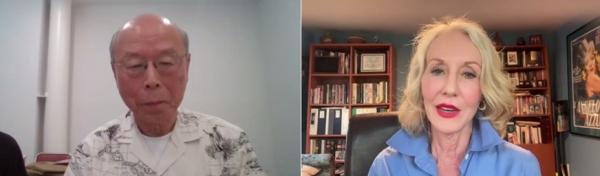
Photo on the left:Mr. Kazuhiko Futagawa Photo on the right:Ms. Mary Dickson
In the first webinar session, Mr. Kazuhiko Futagawa, a survivor who was exposed to radiation while still in his mother’s womb, was invited as a guest speaker. Through his personal history and his family’s experiences, he shared his reflections on the devastation caused in Hiroshima, as well as the suffering and discrimination faced by atomic bomb survivors in the postwar years.
Having been exposed to radiation before birth, Mr. Futakawa spoke about losing family members as a result of the bombing and the experiences of his family members who lived with the effects of radiation exposure. He conveyed how the impacts of nuclear weapons have continued across generations.
In addition, Ms. Mary Dickson, a writer and a “downwinder” who was exposed to radiation from U.S. nuclear tests, shared her testimony on the impacts of radioactive contamination from nuclear testing on her family and community, as well as the health effects she has experienced. She described how invisible radiation has continued to affect people’s lives and health over the long term, emphasizing that the consequences of nuclear weapons continue to be felt today.
Through the testimonies of both speakers, the webinar highlighted that the issue of nuclear weapons is not merely a matter of history or politics, but a profound humanitarian issue that affects the lives and dignity of individuals. The speakers also emphasized the importance of passing on the voices of atomic bomb survivors and nuclear test victims to future generations, and of strengthening international solidarity and education toward the realization of a world without nuclear weapons.
○ Friday, June 19: The social, environmental, and economic impacts of nuclear weapons
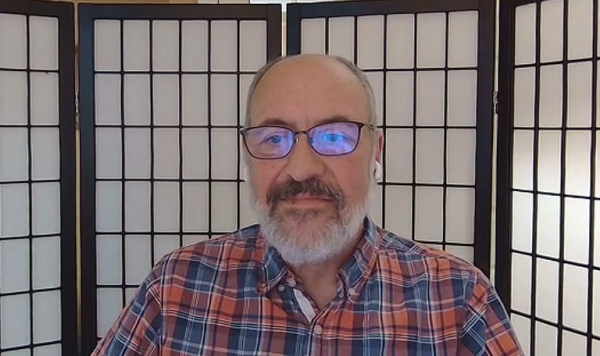
Mr. Robert Jacobs
In this webinar session, historian Robert Jacobs was invited as a guest speaker to give a lecture on the broad and long-term impacts of nuclear weapons on society, the environment, and the economy. In his lecture, Mr. Jacobs focused not only on the survivors of the atomic bombings of Hiroshima and Nagasaki, but also on the “Global Hibakusha” — people around the world who have been affected by radiation from nuclear tests and nuclear-related accidents — highlighting their experiences and the realities of the harm they have suffered. He also discussed how these impacts have not always been fully recognized within conventional scientific assessments and frameworks, as well as the widespread effects of radioactive fallout and the long-term risks posed by nuclear waste to future generations.
Furthermore, Mr. Jacobs emphasized that nuclear issues have been deeply connected with colonialism and economic interests, and highlighted the importance of each individual gaining a deeper understanding of these issues and taking action through solidarity across communities and borders toward the realization of a world without nuclear weapons.
○ Tuesday, June 23: Current and future nuclear risks
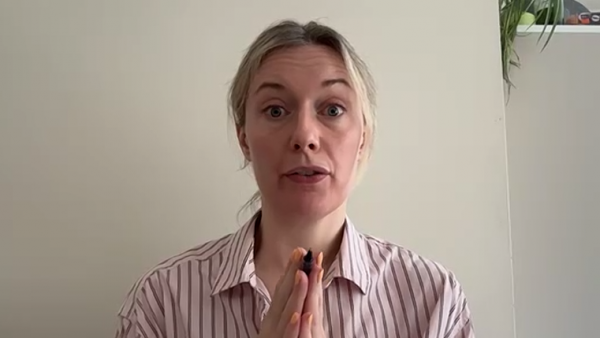
Associate Professor Laura Considine
In this webinar session, Ms. Laura Considine, Associate Professor in the International Politics at the University of Leeds was invited as a guest speaker to give a lecture on the fundamental concepts of nuclear deterrence and how it has historically come to be accepted as something that can be “managed.”
In her lecture, Ms. Considine critically examined the concept of “risk reduction,” which has become an important focus in contemporary nuclear policy. She explained that approaches based on quantified risk management may make the inherent uncertainty and serious threats posed by nuclear weapons less visible. She also explored how the underlying assumption of “rationality” in nuclear deterrence theory has been influenced by values shaped by gender perspectives and colonial histories.
Furthermore, Ms. Considine emphasized that nuclear deterrence is not merely a theoretical concept or a technical policy tool, but a political and ethical choice. She highlighted the importance of questioning its underlying assumptions and perspectives from diverse viewpoints. The session underscored the need to approach discussions on nuclear issues from a broader perspective and to deepen dialogue toward the realization of a world without nuclear weapons.
○ Wednesday, July 1: The roles of the UN and civil society for nuclear disarmament

Photo on the left:Ms. Melissa Parke Photo on the right:Mr. Seth Sheldon
In this webinar session, Ms. Melissa Parke, Executive Director of the International Campaign to Abolish Nuclear Weapons (ICAN), and Mr. Seth Sheldon, General Counsel and United Nations of the International Campaign Liaison to Abolish Nuclear Weapons (ICAN) were invited as guest speakers to give lectures on the significance of the Treaty on the Prohibition of Nuclear Weapons (TPNW) perspectives for the concept of nuclear deterrence.
In their lectures, they discussed the serious humanitarian and environmental impacts of nuclear weapons, drawing on testimonies from atomic bomb survivors in Hiroshima and Nagasaki, as well as those affected by nuclear testing. They also highlighted the challenges of the belief that nuclear weapons provide security and explained the need for international frameworks that do not rely on nuclear deterrence.
In addition, a video message from Mr. Christopher King, Deputy Chief of the Weapons of Mass Destruction Branch and Head of the Science and Technology Unit of UNODA, was introduced. The message emphasized the importance of collaboration between international organizations and civil society in advancing efforts toward a world free of nuclear weapons.
Through this webinar, a hopeful message was conveyed: the voices and actions of individuals can become a force that moves the international community and serve as a driving force toward the abolition of nuclear weapons.
○ Thursday, July 2: Bridging Divides to Advance Nuclear Disarmament
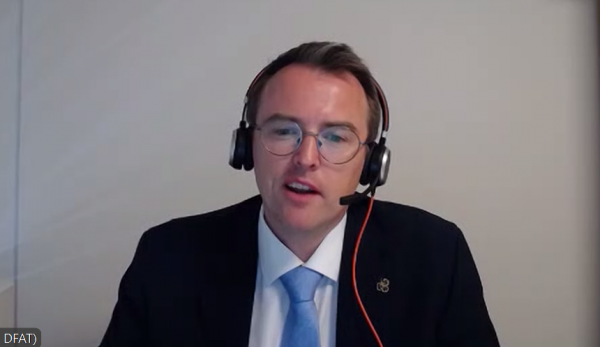
Mr. Jason Robinson
In the final webinar session of the program, the discussion focused on this year’s overall theme, “Bridging divides to Advance Nuclear Disarmament.”
For this session, Mr. Jason Robinson, Deputy Permanent Representative to the Conference on Disarmament at the Permanent Mission of Ireland to the United Nations in Geneva, was invited as a guest speaker and delivered a lecture on Ireland’s efforts in the field of nuclear disarmament.
Mr. Robinson introduced Ireland’s initiatives related to the Treaty on the Non-Proliferation of Nuclear Weapons (NPT) and the Treaty on the Prohibition of Nuclear Weapons (TPNW), as well as its engagement in discussions on the United Nations Intergovernmental Panel on the Effects of Nuclear War. He also explained the role Ireland has played in advancing international efforts toward nuclear disarmament.
During the Q&A session, participants raised a wide range of questions, including how dialogue with nuclear-armed states should be pursued and how gender perspectives and a victim-centered approach can be incorporated into disarmament frameworks. These discussions led to a lively exchange of views.
Through this session, it was reaffirmed that dialogue and cooperation among countries with different positions and perspectives are essential to building bridges and advancing nuclear disarmament efforts.